
Is Your Horse “Bad” or Is Their Gut Burning?

The Hidden Link Between Behaviour and the Hindgut
We’ve all seen it, and many of us have lived it.
A horse that pins its ears when the saddle appears. A horse that snaps when the girth is tightened. A horse that suddenly becomes resistant, tense, unwilling, or explosive under saddle despite having previously been a willing partner.
The traditional response is often predictable.
“He’s testing you.”
“She’s trying to be dominant.”
“You need to be firmer.”
But deep down, most owners know their horse. They know when something has changed. They know when a willing horse suddenly becomes reluctant. They know when what appears to be a training issue may actually be a cry for help.
Whether your horse is a mare, gelding, or stallion, one reality remains the same: many behavioural problems have far less to do with attitude than people imagine, and far more to do with physical discomfort.
In many cases, that discomfort originates deep within the hindgut.
The Forgotten Connection Between Digestion and Behaviour
Over many years of working with horses that had been labelled difficult, dangerous, stubborn, sour, lazy, or resistant, I began noticing a pattern.
Time after time, when digestive health improved, behaviour improved.
Horses that objected to saddling became cooperative.
Horses that pinned their ears became relaxed.
Horses that resisted transitions became willing.
Horses that had been labelled behavioural problems often transformed without any significant change in training methods.
The more I observed this relationship, the more convinced I became that many so-called behavioural issues originate not in the horse’s mind, but within the digestive tract itself.
The Hindgut: The Horse’s Largest Fermentation Chamber
To understand why, we need to look beyond the stomach and into the cecum and large colon.
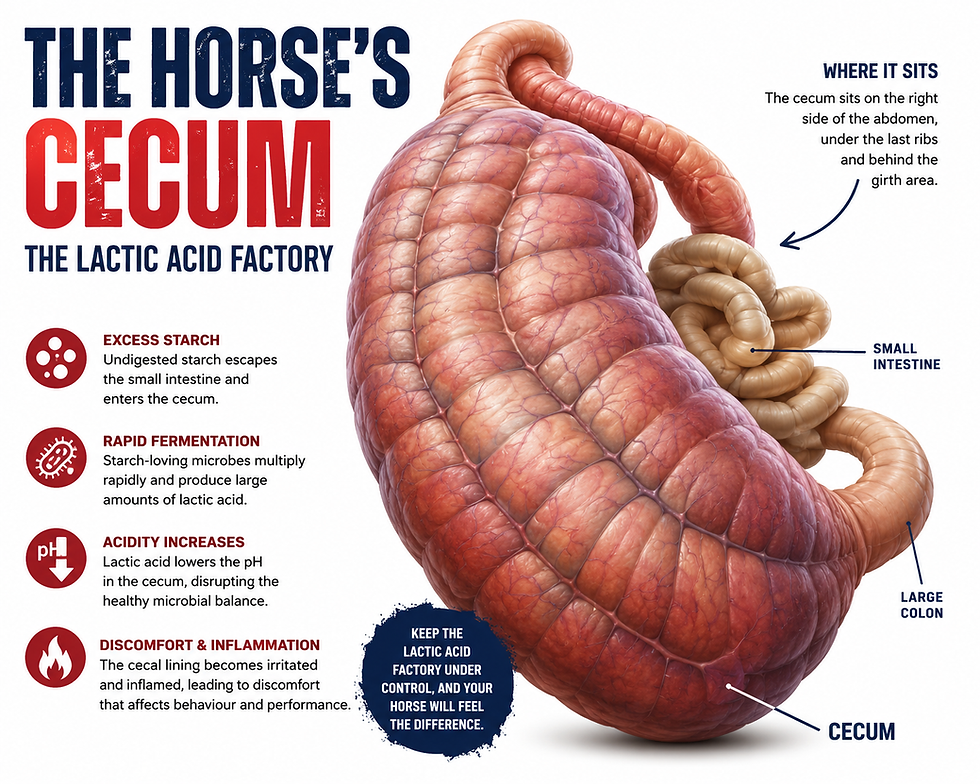
Together, these structures form an enormous fermentation chamber occupying much of the horse’s abdomen. The cecum alone can hold more than 30 litres of fermenting feed and fluid.
This remarkable organ houses billions of microorganisms responsible for breaking down fibre and producing many of the nutrients essential to the horse’s health.
When this environment is stable, the horse thrives.
When it becomes acidic and inflamed, the consequences can affect far more than digestion.
When Raw Starch Reaches the Wrong Destination
The horse evolved as a grazing herbivore, consuming fibre-rich forage for much of the day.
However, many modern feeding programs rely heavily on cereal grains, sweet feeds, molasses, and other sources of raw starch.
The horse’s small intestine has only a limited capacity to digest raw starch.
When that capacity is exceeded, undigested starch escapes into the hindgut.
This is where the trouble begins.
Rapid Fermentation
Starch-loving bacteria multiply rapidly and ferment the excess starch.
Lactic Acid Production
As these microbes flourish, large quantities of lactic acid are produced.
Falling pH
The increasing acidity lowers the pH of the hindgut and disrupts the delicate microbial balance.
Fibre-Digesting Microbes Begin to Die
The beneficial microorganisms responsible for healthy fibre digestion struggle to survive in this increasingly acidic environment.
Inflammation and Ulceration
The lining of the cecum and large colon becomes irritated, inflamed, and in some cases ulcerated.
What follows is not simply a digestive problem.
It becomes a comfort problem.
And comfort directly influences behaviour.
Why Saddling and Riding Can Trigger Resistance
Now imagine carrying a large, inflamed fermentation chamber inside your abdomen.
The saddle is placed on your back.
The girth is tightened around your barrel.
You are asked to engage your core, bend around the rider’s inside leg, lift your back, and drive forward from your hindquarters.
Every one of these actions changes pressure within the abdomen.
If the tissues of the hindgut are inflamed and painful, those movements can become uncomfortable.
Suddenly many common behaviours begin to make perfect sense.
The horse is not trying to be difficult.
The horse is trying to protect itself.
Common Signs of Hindgut Discomfort
Girthiness
Biting, pinning the ears, kicking at the belly, moving away, or showing obvious resentment during saddling.
The Cold-Backed Horse
A horse that starts work stiff, hollow, tense, or uncomfortable before gradually loosening up.
Resistance to Bending
Many horses with hindgut discomfort become noticeably more resistant in one direction, particularly when compression of sensitive abdominal structures occurs.
Difficulty With Transitions
The horse may resist moving forward, engaging the hindquarters, or stepping willingly into canter.
Sudden Explosive Behaviour
Buck, bolt, rear, or rush seemingly without warning when additional abdominal effort is required.
Changes in Temperament
The horse that was once soft becomes defensive.
The horse that was once willing becomes resistant.
The horse is not plotting against its rider.
It is responding to discomfort.
The Difference Between Raw Starch and Digestible Starch
One of the greatest misconceptions in equine nutrition is the belief that all starch behaves the same way.
It does not.
Raw starch and properly processed starch are very different.
Raw starches from many traditional grain-based feeds are often incompletely digested in the small intestine. Significant quantities may spill into the hindgut where they contribute to the chain reaction that leads to lactic acid production and acidity.
Properly gelatinised starches behave differently.
The gelatinisation process makes the starch far more digestible in the small intestine, allowing the horse to utilise the energy where nature intended and dramatically reducing the amount reaching the hindgut.
This distinction is critical.
The problem is not energy.
The problem is where that energy is being digested.
Treat the Cause, Not the Symptom
Modern veterinary medicine has developed medications that can suppress stomach acid and assist horses suffering from gastric ulcers.
These products may provide valuable short-term relief when stomach ulcers are present.
However, no medication can permanently overcome a feeding program that continually delivers excessive amounts of raw starch into a digestive system that was never designed to handle it.
If the underlying causes remain unchanged, stress, inappropriate feeding practices, prolonged periods without forage, and excessive raw starch intake, then many horses simply find themselves returning to the same digestive challenges.
True long-term improvement requires addressing the cause.
That means reducing stress wherever possible.
It means providing adequate forage.
And it means feeding in a way that supports the biological design of the horse.
This philosophy forms the foundation of Thrive Feed.
Rather than relying on raw grain and molasses, Thrive Feed is built around highly digestible forage-based ingredients and carefully processed energy sources designed to support efficient digestion while minimising the risk of hindgut overload.
The goal is simple.
Support the hindgut rather than challenge it.
Listen to What Your Horse Is Saying
Horses rarely wake up in the morning planning to challenge their owners.
Behaviour is communication.
Before assuming a horse is stubborn, dominant, lazy, sour, or naughty, it is worth asking a simple question:
“What if the horse is hurting?”
Sometimes the answer is not found in the bit.
Sometimes it is not found in the saddle.
Sometimes it is not found in another training session.
Sometimes the answer is buried deep within the hindgut.
And when that discomfort is addressed, the horse many people thought needed discipline often turns out to be exactly what they always were:
A willing partner simply asking for help.


Comments