
Your Horse’s Manure, The Daily Report Card on Digestive Health


In my previous article, I explained that digestion begins in the horse’s mouth. Efficient chewing, thorough salivary saturation, and the formation of well-lubricated food boluses are the essential first steps in extracting nutrients from forage.
The other end of the digestive tract provides an equally valuable source of information.
Every pile of manure is a daily report card. It tells us how efficiently the digestive system has functioned, whether the microbial population in the hindgut is healthy, whether feed has been properly processed, and often provides the earliest indication that something has changed long before the horse appears clinically unwell.
Horse owners often ignore manure unless it becomes diarrhoea or the horse develops colic. In reality, healthy manure is one of the most valuable diagnostic tools available, and every horse owner should learn how to interpret what it is saying.
What Healthy Manure Looks Like
Healthy manure should consist of well-formed individual faecal balls that hold their shape while remaining moist and resilient. They should separate naturally when dropped, have an earthy smell, and contain finely digested plant fibres rather than long strands of undigested forage.
Healthy manure tells us that chewing has been effective, saliva has prepared the food correctly, hindgut fermentation is functioning normally, and water absorption within the large intestine is balanced.
Quantity Matters
The volume of manure produced can be just as important as its appearance.
A healthy horse consuming adequate forage should produce a relatively consistent number of manure piles each day, typically between eight and twelve.
A noticeable reduction in manure output often indicates reduced feed intake, dehydration, slowed intestinal motility, developing impaction, pain, or illness. Likewise, a sudden increase in manure production may reflect dietary changes, lush pasture intake, stress, or altered hindgut fermentation.
Owners should become familiar with what is normal for their horse. Changes in quantity are often among the earliest warning signs that digestive function is becoming compromised.
Hard, Dry Faecal Balls
Very dry, hard manure generally indicates excessive water absorption within the large intestine.
Possible causes include dehydration, reduced water intake, dry forage, reduced intestinal motility, or the early stages of an impaction.
This should never be ignored, as constipation and impaction colic often develop gradually rather than suddenly.
Soft or Flattened Faecal Balls
When manure begins to lose its shape and individual balls flatten or merge together, feed is usually moving through the digestive tract more rapidly than normal.
This may result from sudden dietary changes, lush pasture, stress, or disruption of the hindgut microbial population.
These changes often appear before the horse shows any obvious clinical signs.
Cow-Pat Manure
Cow-pat consistency manure commonly indicates excessive water remaining within the intestinal contents and often reflects changes in hindgut fermentation.
However, there is one important exception.
When horses in poor body condition are being rehabilitated using large amounts of Thrive Feed, very soft manure is both common and expected. The highly micronised nature of the feed allows it to be digested differently from traditional feeds, and during the early stages of nutritional rehabilitation this frequently produces cow-pat-like manure.
This is entirely normal and should not automatically be interpreted as digestive disease.
As the horse regains condition and the proportion of forage increases, while Thrive Feed is gradually reduced to a maintenance level of approximately four pounds (around 1.8 kilograms) per day for an average-sized horse, manure consistency generally returns to normal, well-formed faecal balls.
Understanding the dietary context is essential before interpreting manure quality.
Diarrhoea
True diarrhoea should always be investigated.
It may indicate serious inflammation of the large intestine, infectious disease, toxicity, severe microbial disruption, or other significant intestinal disease.
Persistent diarrhoea requires prompt veterinary attention because dehydration and electrolyte loss can occur rapidly.
Long Fibre in the Manure
Long pieces of hay or grass within the manure often indicate that forage has not been adequately processed in the mouth.
Common causes include poor dentition, worn molars, missing teeth, painful dental abnormalities, or inadequate chewing.
This reinforces the importance of the first stage of digestion discussed in my previous article. If feed is not properly broken down and thoroughly saturated with saliva before it is swallowed, every stage of digestion that follows becomes less efficient.
The appearance of long fibre in manure is often visible evidence that the horse failed to create a finely divided, properly lubricated food bolus before swallowing.
Digestion begins in the mouth, and the manure often tells us when that process has not occurred efficiently.
Whole Grain in the Manure
Finding whole grain kernels in manure is surprisingly common when horses are fed sweet feeds or whole cereal grains.
Many grain berries pass through the digestive tract virtually unchanged because they escape complete crushing by the horse’s teeth.
This should not surprise us.
Grain berries are not simply food; they are the reproductive system of grasses.
Nature designed grazing animals to transport those seeds to new locations where they are deposited in nutrient-rich manure, providing ideal conditions for germination.
To achieve this remarkable survival strategy, seeds possess natural protective mechanisms. They contain compounds such as phytic acid, together with naturally occurring enzyme inhibitors, that help protect their nutrient reserves from premature digestion.
When the seed eventually becomes hydrated in suitable soil, germination begins. The seed activates its own metabolism, including the enzyme phytase, which breaks down the phytic acid and releases the stored nutrients required for the young plant to grow.
In other words, the grain berry was designed to survive digestion, not to be digested.
For this reason, raw cereal grains are not an ideal foundation for equine nutrition. Even feeds based predominantly on raw grains, despite being cracked or pelleted, retain many of these biological characteristics.
Whole grain appearing in manure is visible evidence that valuable nutrition has escaped digestion, while undigested starch entering the hindgut may disrupt the microbial population responsible for fibre fermentation. With raw grain in the manure, you are watching your money get wasted.
What the Manure Tells Us About the Hindgut
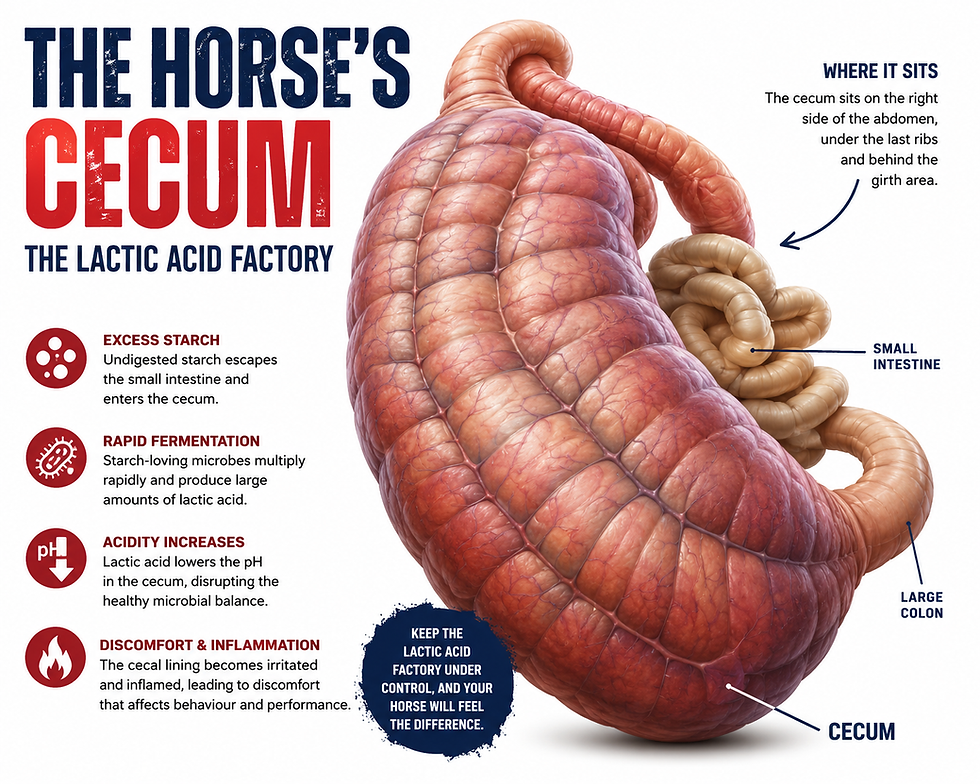
The horse’s hindgut contains trillions of beneficial microorganisms that ferment fibre and produce volatile fatty acids, which supply a significant proportion of the horse’s daily energy requirements.
Healthy manure reflects a healthy microbial population.
When the hindgut environment becomes disrupted through sudden dietary changes, excessive starch intake, stress, illness, or inappropriate feeding practices, manure quality often changes long before other clinical signs become obvious.
For this reason, manure provides one of the earliest visible indicators of hindgut health.
Mucus
Occasional small amounts of mucus may simply reflect normal lubrication of the large intestine.
Repeated or excessive mucus, however, often indicates irritation or inflammation within the bowel.
Dietary change, hindgut microbial disturbance, sand accumulation, and inflammatory bowel disease are all possible causes.
Persistent mucus deserves investigation rather than being dismissed as normal.
Sand in the Manure
Horses grazing sandy soils or eating feed from the ground in dry paddocks may inadvertently consume significant amounts of sand.
Small quantities may pass harmlessly through the digestive tract, but accumulation within the large intestine can irritate the intestinal lining and interfere with normal gut function.
In severe cases, sand accumulation may contribute to chronic diarrhoea, weight loss, and colic.
A simple monitoring technique involves placing a manure sample in a clear container of water, shaking it thoroughly, and allowing it to settle. Sand will sink to the bottom while organic material remains suspended.
Regular monitoring is particularly important for horses living on sandy country.
Smell Matters
Healthy manure has a pleasant earthy, fermented smell.
A sour, putrid, or unusually offensive odour often reflects abnormal fermentation within the hindgut and should prompt closer examination of the horse’s diet and digestive health.
Consistency Is More Important Than Perfection
Many owners become concerned when a manure pile does not look exactly like a textbook example.
The reality is that every horse is an individual.
Some horses naturally produce slightly softer manure, while others consistently produce firmer faecal balls. Factors such as forage type, climate, water intake, workload, and age all influence manure appearance.
The most important observation is not whether the manure is perfect, but whether it remains consistent for that particular horse.
A sudden change in manure quality is often more significant than the manure’s appearance itself.
Your Horse Produces a Digestive Health Report Every Day
Most horses produce between eight and twelve piles of manure every day.
That gives owners eight to twelve opportunities to monitor digestive health before disease develops.
Learning to assess manure consistency, moisture, fibre length, grain content, mucus, sand content, odour, and daily output is one of the simplest yet most powerful management tools available.
The digestive tract begins its work in the mouth with efficient chewing and salivary saturation. It continues through the stomach, small intestine, cecum, and large colon, where billions of beneficial microorganisms transform plant fibre into usable nutrition. It finishes by producing a visible report card that reflects the success, or failure, of every stage of that process.
Every manure pile represents valuable information. Long before weight loss, colic, poor performance, or illness become obvious, the digestive tract often provides subtle clues that something has changed.
The horse is communicating with us every day.
The question is not whether the message is there.
The question is whether we are paying attention.


Dale introduced us to Trive feed 10 years ago. We won’t use anything else. He knows more about horse nutrition than many vets.