
The First Step of Digestion Begins in the Mouth


Most horse owners understand that digestion involves the stomach, small intestine, and hindgut. What is often overlooked is that digestion actually begins the moment a horse starts chewing.
The horse’s mouth is not simply a mechanism for reducing feed particle size. It is the first and one of the most important stages of the digestive process.
The Remarkable Saliva Factory
A mature horse typically produces between 30 and 40 litres (8 to 10 gallons) of saliva every day. Unlike humans, horses produce saliva primarily in response to chewing. The more chewing activity that occurs, the more saliva is produced.
This saliva serves several critical functions:
• Moistens and lubricates feed.
• Forms the feed into a swallowable bolus.
• Buffers stomach acidity.
• Delivers digestive enzymes to the feed before it reaches the stomach.
• Supports efficient digestion further down the digestive tract.
Nature designed the horse to spend many hours each day chewing forage. This prolonged chewing ensures that every mouthful becomes thoroughly saturated with saliva before being swallowed.
Alpha-Amylase, The Forgotten Enzyme
One of the components of equine saliva is alpha-amylase, an enzyme involved in the earliest stages of starch digestion.
As the horse chews, saliva coats every feed particle. Alpha-amylase begins attacking starch molecules on the surface of those particles, starting the digestive process before the feed even reaches the stomach.
At the same time, chewing reduces particle size and dramatically increases the surface area available to digestive enzymes later in the digestive tract.
Think of chewing as nature’s feed-processing plant. The horse is preparing the feed mechanically and biochemically before swallowing ever occurs.
Why Chewing Matters
Every chew performs three vital functions simultaneously:
Reduces particle size.
Mixes the feed thoroughly with saliva.
Increases the surface area available for enzymatic digestion.
The result is a properly prepared feed bolus entering the stomach and eventually the small intestine.
When this process is allowed to occur naturally, digestion is highly efficient.
The Problem with Soaking Conventional Horse Feeds
Many horse owners routinely soak conventional grain-based feeds before feeding. While soaking may occasionally be necessary for horses with severe dental issues or specific medical conditions, routinely soaking starch-rich feeds can create unintended consequences.
When feed is submerged in water before feeding, several things occur:
The feed absorbs plain water rather than saliva.
Starch granules become hydrated before the horse has had an opportunity to chew and salivate properly.
The horse often consumes the softened feed more rapidly, reducing chewing activity.
Reduced chewing means reduced saliva production.
Reduced saliva means less buffering capacity entering the stomach and less exposure of starch particles to salivary enzymes.
In effect, the feed arrives in the digestive tract carrying water instead of the biological fluid nature intended it to carry.
Water Is Not Saliva
This distinction is critically important.
Water provides moisture.
Saliva provides moisture, digestive enzymes, bicarbonate buffers, mucins, electrolytes, and biological compounds specifically designed to support digestion.
Replacing saliva with water is somewhat like replacing engine oil with water because both are liquids. They are not remotely equivalent.
The horse’s digestive system evolved around salivary saturation, not water saturation.
Raw Starch and Cecal Spillover
Another important consideration is the form in which starch is presented to the horse.
Raw starch granules are relatively resistant to enzymatic digestion because their crystalline structure limits the ability of digestive enzymes to access the starch molecules contained within them.
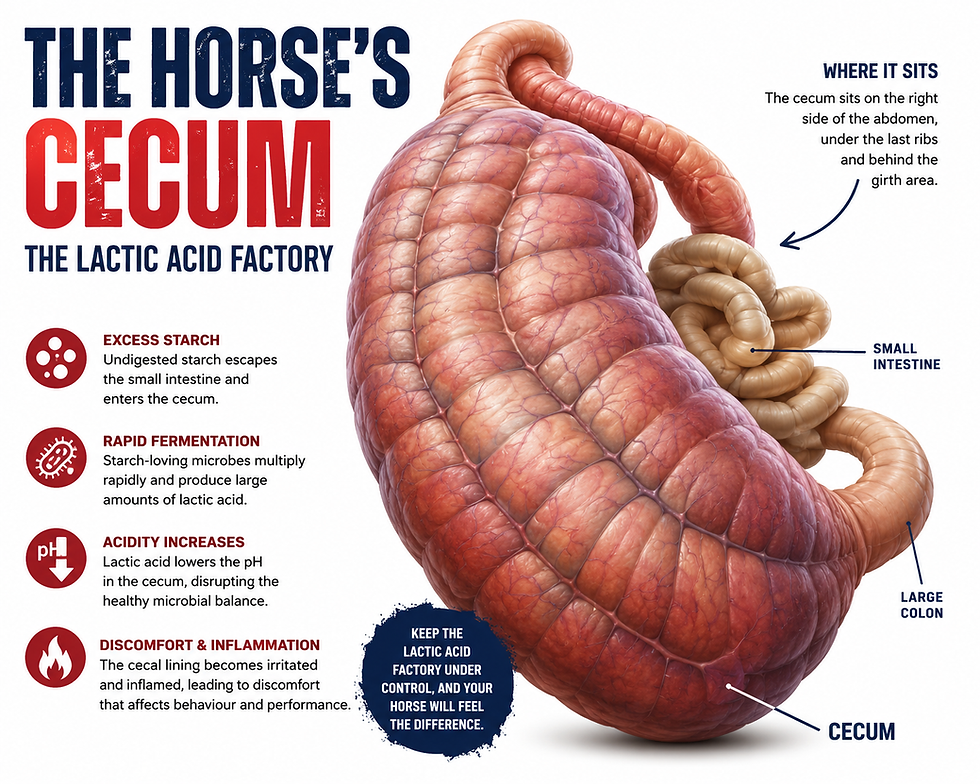
Even when exposed to pancreatic amylase in the small intestine, a significant proportion of raw starch may remain undigested. The consequence is that some of this starch escapes digestion in the small intestine and passes into the cecum and large colon.
This phenomenon is commonly referred to as starch spillover.
The horse’s cecum was designed primarily as a fibre fermentation chamber, not as a starch digestion chamber.
When excessive starch enters this environment, starch-fermenting bacteria rapidly multiply and produce large quantities of volatile fatty acids and lactic acid. As hindgut acidity increases, fibre-digesting microbial populations can be disrupted.
The resulting changes may contribute to:
• Reduced digestive efficiency.
• Hindgut acidosis.
• Altered manure consistency.
• Excessive gas production.
• Behavioural changes in sensitive horses.
• Increased digestive stress.
This is one reason modern feed processing methods such as extrusion, micronisation, steam cooking, and gelatinisation can dramatically improve starch digestibility. These processes alter the structure of starch granules, making them far more accessible to enzymatic digestion in the small intestine and reducing the likelihood of starch reaching the hindgut.
From a digestive standpoint, the goal should always be to maximise starch digestion before the feed reaches the cecum.
A horse was never designed to use the cecum as a starch digestion chamber. The cecum is a fibre fermentation chamber. When significant amounts of raw starch repeatedly arrive in the hindgut, we are asking the wrong part of the digestive system to perform the wrong job.
The Consequences Further Downstream
When starch digestion in the small intestine becomes less efficient, even greater quantities of starch may escape digestion and pass into the hindgut.
The hindgut was designed primarily to ferment fibre, not large quantities of starch.
When excessive starch reaches the hindgut, microbial populations can shift rapidly, potentially contributing to digestive disturbances and reduced fibre utilisation.
While soaking feed alone may not create these problems, reducing chewing and salivary exposure removes an important natural step in the digestive process and may contribute to less efficient starch digestion overall.
Trust the Design
The horse’s digestive system has been refined over millions of years of evolution.
Every chew has a purpose.
Every litre of saliva has a purpose.
Every moment spent processing feed in the mouth has a purpose.
Before a single mouthful reaches the stomach, nature has already begun the digestive process through chewing, salivary saturation, buffering, lubrication, and enzymatic action.
Rather than trying to improve upon that design, horse owners may achieve better results by supporting it.
The mouth is not merely the beginning of the digestive tract.
It is where digestion truly begins.


Comments