
Alfalfa and the Horse: Understanding the Difference Between Feed and Forage
- Dale Moulton
- May 29
- 3 min read


For decades, alfalfa has been promoted as a premium horse feed. It is high in protein, calorie-dense, and often marketed as a superior hay. Yet despite its popularity, many horse owners fail to recognize one critical fact:
Alfalfa is not a grass. It is a legume.
That distinction matters far more than most people realize.
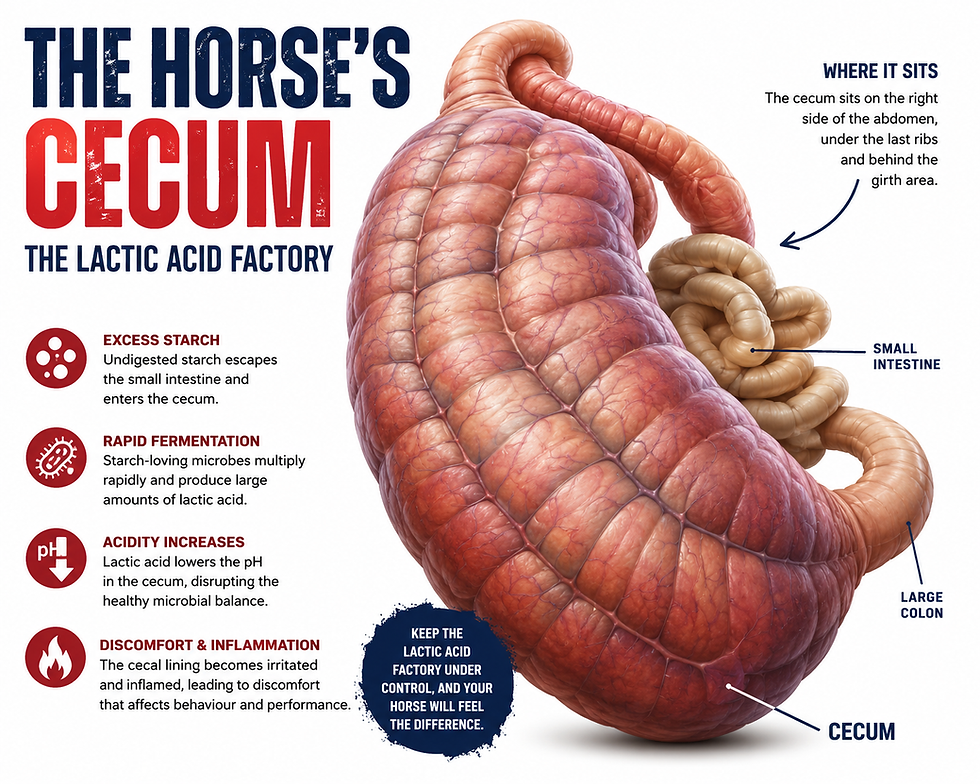
The equine digestive system evolved over millions of years to process grasses and fibrous forage. Horses are hindgut fermenters, relying on an enormously complex microbial population in the cecum and colon to break down cellulose and extract energy from roughage. These microorganisms thrive when the horse consumes a predominantly grass-based forage diet.
When large amounts of alfalfa are introduced as a substitute for grass hay, the fermentation dynamics inside the hindgut begin to change.
The Hindgut: A Delicate Fermentation Chamber
The horse’s hindgut contains billions of cellulolytic bacteria, specialized microorganisms responsible for digesting structural fiber. These bacteria perform best within a relatively stable fermentation environment dominated by grasses and long-stem forage.
Grass hays generally produce a slower, more stable fermentation profile. Alfalfa, however, ferments differently due to its legume composition. It is richer in protein, calcium, and digestible energy, and its nutrient density can significantly alter hindgut activity when fed in excess.
In practical terms, this means the microbial population in the hindgut can be pushed away from the environment it evolved to operate within.
The result may include:
Reduced microbial efficiency
Digestive instability
Altered manure consistency
Excessive energy or excitability in some horses
Increased metabolic stress
Reduced forage balance
While some horses tolerate large quantities of alfalfa reasonably well, others show subtle but important changes in behavior, gut comfort, and overall balance.
Feed Versus Forage
One of the greatest mistakes in modern horse nutrition is confusing a nutritional supplement with a foundational forage source.
Alfalfa can absolutely have a place in equine nutrition. It can be useful:
For hard keepers
During heavy work
For lactating mares
In carefully controlled performance diets
As a protein and calorie supplement
But problems often arise when alfalfa stops being a supplement and starts becoming the primary forage source.
This is where many feeding programs drift away from what the equine digestive system was designed to handle.
The Grass-Based Horse
If we examine horses in more natural environments, one thing becomes obvious: horses evolved grazing grasses, not consuming large quantities of legumes.
Grasses create the long-duration chewing cycles, saliva production, fiber breakdown, and microbial stability that the equine hindgut depends upon.
This does not mean alfalfa is “bad.”
It means context matters.
A small percentage of alfalfa within a predominantly grass-based forage system may provide benefits without substantially disrupting hindgut fermentation dynamics.
My Recommendation
As a general guideline, I recommend that alfalfa should not exceed approximately 20% of the total forage intake in most horses.
This allows horse owners to gain the nutritional advantages of alfalfa while still maintaining a fermentation profile dominated by grasses and structural fiber.
The remaining 80% should ideally come from quality grass hays or pasture appropriate to the horse’s workload, condition, and metabolic status.
In many cases, horses perform better physically and mentally when their forage program is simplified and returned closer to the natural design of the equine digestive system.
Final Thoughts
Modern horse feeding has increasingly moved toward calorie density, supplementation, and convenience. Yet the horse remains fundamentally a grazing herbivore built around continuous fiber fermentation.
The more we respect biology, the better outcomes we tend to see.
Alfalfa is not inherently harmful. But it should be understood for what it is, a legume with a markedly different fermentation profile than grass.
Used intelligently and in moderation, it can be beneficial.
Used excessively as a replacement for grass forage, it may create digestive and metabolic consequences that many horse owners never recognize as forage-related.
Sometimes the best thing we can do for horses is not to add more complexity to the diet but to return to the simplicity their digestive system evolved to thrive upon.


Comments