
Forage Is Heat

Feeding the Winter Furnace Across North America
When winter arrives, most people think first about blankets.
Experienced horsemen think first about forage.
Because the most powerful winter heater a horse possesses is not fabric.
It is fermentation.
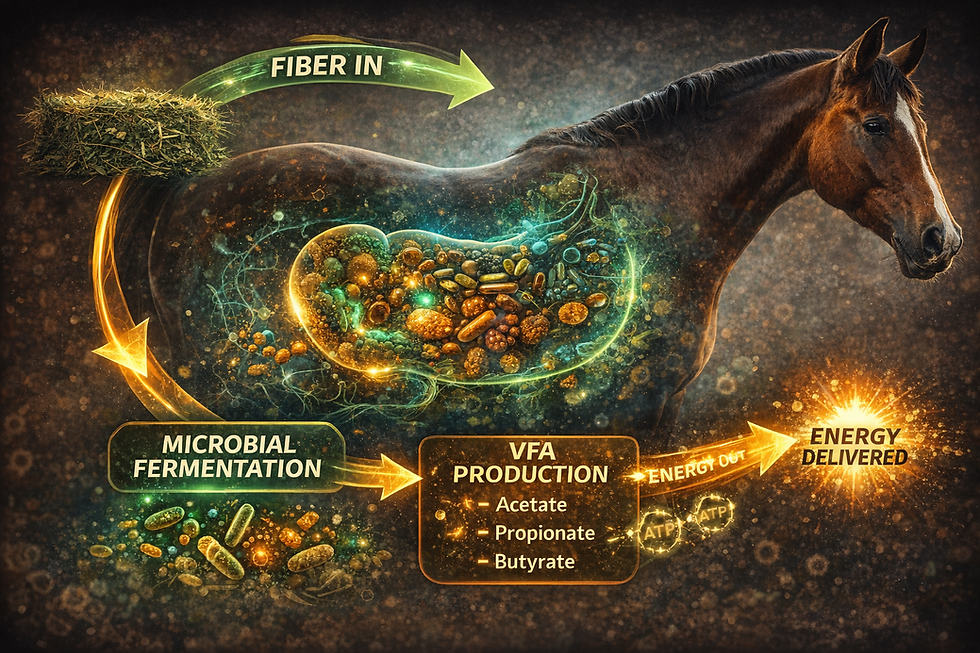
A horse stays warm from the inside out, and the foundation of that warmth is fiber.
The Horse’s Real Heater Is the Hindgut
Horses are grazing animals designed to process forage continuously. Their digestive tract functions as a slow, steady furnace.
When fiber is fermented in the hindgut, the process produces substantial metabolic heat. This is one of the primary ways horses maintain body temperature through cold weather.
In practical terms, hay is not just food in winter.
Hay is heat.
Why Cold Weather Increases Nutritional Demand
In harsh conditions, the horse must spend more energy maintaining body temperature.
The colder the weather, especially when combined with wind or wetness, the more calories are required simply for maintenance.
That does not mean the horse needs more grain.
It means the horse needs more appropriate fuel.
The most natural and effective winter fuel is forage.
Consistency Matters More Than Quantity
Winter feeding is not about sudden increases or dramatic changes.
It is about consistency.
Horses handle winter best when forage intake is steady, predictable, and continuous.
Long gaps without forage are not just uncomfortable, they reduce the digestive warmth that fiber provides.
A horse with access to steady hay is often warmer than a horse with intermittent concentrate meals.
Forage First is Not a Slogan, It Is Biology
Owners sometimes underestimate how central fiber is to winter health.
The winter horse thrives on:
Adequate hay intake
Consistent feeding rhythms
High quality fiber digestion
Stable water access
This is what keeps the internal environment steady.
It also supports calmer demeanor, because hunger and volatility create stress.
Water, the Forgotten Winter Nutrient
Cold weather feeding always comes back to one critical point.
Hydration.
Horses may drink less in winter, especially if water is icy or unpalatable. Reduced intake affects digestion immediately.
Fiber without water becomes harder to process.
In winter, ensuring clean, unfrozen, appealing water is not optional.
It is foundational.
Warm water availability can make a remarkable difference.
When Horses Need More Than Hay
Most healthy horses do very well with forage as the primary winter foundation.
However, some horses require additional support:
Hard keepers
Seniors with poor dentition
Horses in heavy work
Horses unable to consume enough hay volume
Horses in extreme cold environments
In these cases, the solution is still rooted in fiber based nutrition, not starch volatility.
Winter is not the time for metabolic spikes.
Winter is the time for steady fuel.
Thrive Feed’s View
At Thrive Feed, we believe winter management starts where the horse starts.
With forage.
With rhythm.
With biological steadiness.
The best winter horse is not the most rugged.
It is the most consistently fed, well sheltered, and calmly managed.
Because in North America’s cold seasons, warmth is not built from blankets alone.
Warmth is built from fiber, routine, and the winter furnace within.

Comments