
You Don’t Own a Horse, You Manage a Microbial Reactor

Let’s strip this right back to first principles.
A horse is not an engine powered by what it eats.
A horse is an energy system powered by what its microbes produce.
If you want to understand performance, condition, behaviour, or disease, you have to stop looking at the horse as a single organism and start looking at it as a host supporting a fermentation reactor.
Because that is exactly what it is.
The Hindgut, A Continuous Fermentation Chamber
The equine digestive system is split into two fundamentally different environments.
The foregut, stomach and small intestine, is enzymatic.
The hindgut, caecum and colon, is microbial.
The foregut has limited capacity. It handles soluble nutrients, simple sugars, some starch, amino acids, and fats. It is fast, selective, and relatively small.
The hindgut is where the real work happens.
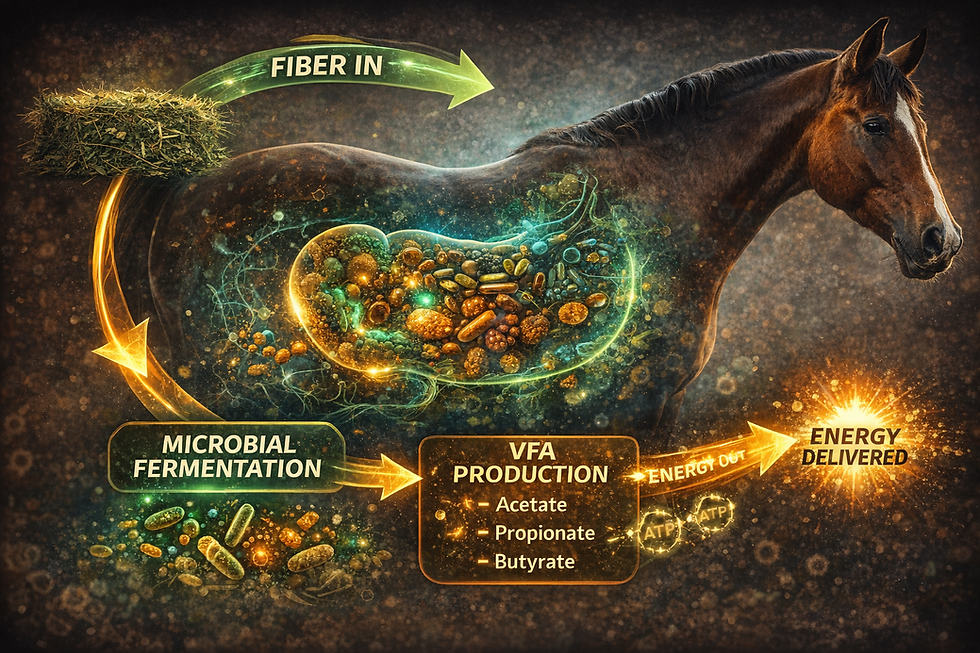
The caecum and colon form a large, anaerobic fermentation chamber, effectively a bioreactor, housing billions of bacteria, protozoa, and fungi. These microbes break down structural carbohydrates, cellulose, hemicellulose, and pectins, that the horse itself cannot digest.
This is not optional digestion.
This is the primary energy pathway.
From Fibre to Fuel, The VFA Engine
When fibre enters the hindgut, microbes ferment it.
The products of that fermentation are volatile fatty acids, primarily:
Acetate
Propionate
Butyrate
These are not byproducts.
They are the horse’s main fuel source.
Acetate is used directly by muscle and is the dominant fuel for low to moderate intensity work.
Propionate is transported to the liver and converted into glucose via gluconeogenesis.
Butyrate fuels the cells lining the gut and maintains intestinal integrity.
At any given time, a significant proportion of a horse’s energy, often the majority, is derived from these VFAs.
So when you look at a horse moving, working, or simply standing in a paddock, what you are seeing is energy generated by bacteria.
The Fragility of the System
This system is powerful, but it is not bulletproof.
It depends on:
Stable pH
Consistent substrate supply
Balanced microbial populations
Continuous intake of fibre
When these conditions are met, fermentation is steady, efficient, and safe.
When they are not, the system destabilises quickly.
Excess starch that escapes the small intestine enters the hindgut and is rapidly fermented by lactic acid producing bacteria. This causes:
A drop in pH
Death of fibre digesting microbes
Release of endotoxins
Increased gut permeability
This is the beginning of a cascade that can lead to:
Laminitis
Colic
Behavioural changes
Systemic inflammation
Not because the horse is “sensitive”
But because the reactor has been disrupted.
Evolution Did Not Design for Convenience Feeding
Horses evolved as continuous grazers.
They moved slowly across large areas, consuming small amounts of fibrous forage almost constantly. This created:
A steady flow of substrate into the hindgut
Stable microbial populations
Consistent fermentation patterns
Minimal metabolic shock
Modern feeding practices have moved away from this model.
Large meals.
High starch feeds.
Infrequent feeding.
Highly processed inputs disconnected from natural forage structure.
From a microbial perspective, this is not just different.
It is disruptive.
You are no longer feeding a steady-state reactor.
You are creating spikes, crashes, and instability.
The NSC Oversimplification
Non-structural carbohydrates matter. That is not in question.
But the industry has reduced a complex biological system to a single number.
NSC does not tell you:
How a feed behaves in the hindgut
How quickly it is fermented
What microbial populations it favours
How it interacts with existing forage
You can feed low NSC and still destabilise the system if the diet lacks structure, diversity, or consistency.
You can also support a stable system with higher energy inputs when they are introduced correctly and supported by fibre.
The number is not the system.
You Are Managing a Living Ecosystem
If you accept that the horse is a microbial reactor, your role changes completely.
You are not selecting feed based on convenience or marketing claims.
You are managing:
Microbial diversity
Fermentation stability
Substrate flow
Gut integrity
That means thinking in terms of:
Consistency over extremes
Fibre over quick energy
Adaptation over sudden change
Function over formulation
Where This Leaves Us
The industry has drifted.
Not because people do not care, but because we have tried to simplify something that is inherently complex.
We have replaced biology with numbers.
We have replaced systems with products.
But the horse has not changed.
It is still doing exactly what it evolved to do.
Running on bacteria.
Responding to fermentation.
Living or struggling based on the stability of that internal ecosystem.
The Takeaway
You don’t own a horse.
You manage a microbial reactor.
Get the reactor right, and the horse thrives.
Get it wrong, and no amount of supplementation, medication, or intervention will fully compensate.
Because at the core of everything the horse is, there is a system.
And that system is microbial.

Comments