
Horses Are Bacteriologists

Let’s get something straight.
Horses are not carbohydrate managers.
They are not calorie counters.
They are not protein seekers.
Horses are bacteriologists.
Every mouthful a horse takes is not about feeding the horse first.
It is about feeding the microbial population that lives inside the horse.
That population, the hindgut bacteria, is the real engine.
The Real Horse Lives in the Hindgut
Inside every horse is a living ecosystem.
Billions of bacteria, constantly working, constantly adapting, constantly deciding what happens next.
When a horse eats, it is not just consuming feed.
It is selecting substrates for fermentation.
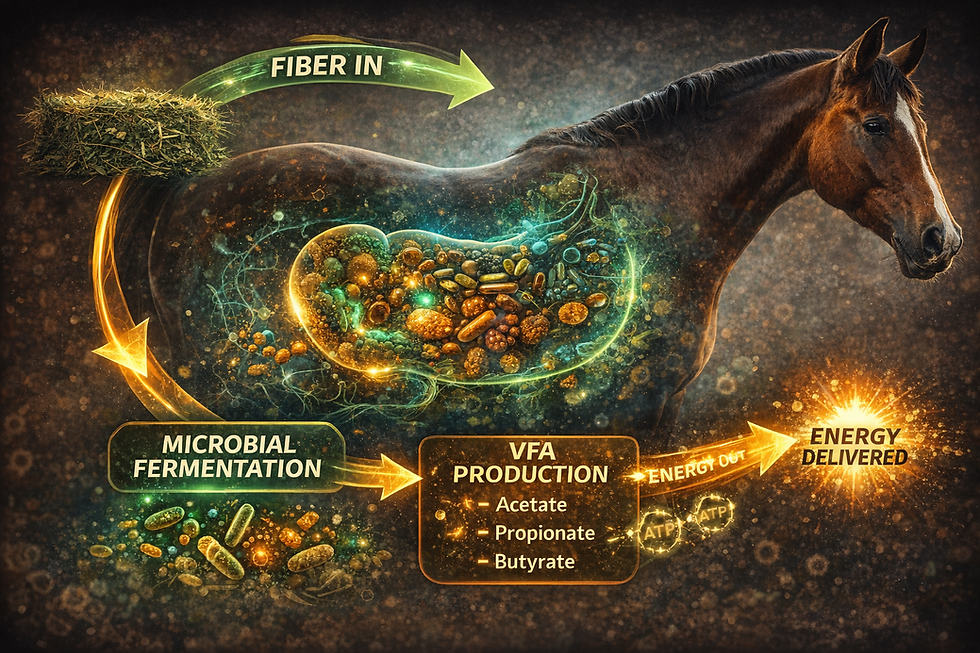
Fibre goes in.
Bacteria break it down.
Volatile fatty acids are produced.
Energy is created.
That is how a horse runs.
Not on starch.
Not on sugar.
On bacterial fermentation.
You Are Not Feeding a Horse, You Are Feeding a System
This is where most people get it wrong.
They look at a feed tag and focus on numbers like NSC as if that single number defines safety, performance, or health.
It does not.
Because the horse does not read the tag.
The bacteria respond to the total input, structure, particle size, fermentability, mineral balance, and feeding pattern.
You can feed something “low NSC” and still disrupt the hindgut.
You can feed something higher in energy and maintain stability if the bacterial population is supported.
That is the difference between feeding ingredients and feeding function.
Bacterial Stability Is Everything
When the microbial population is stable, everything works.
Digestion is efficient.
Energy is steady.
Manure is consistent.
The horse is calm, focused, and metabolically balanced.
When it is not, everything unravels.
Gas production increases.
pH drops.
Microbial populations shift.
Toxins are released.
And suddenly you are dealing with issues that people try to label as:
Laminitis.
Colic.
Behaviour problems.
“Metabolic horses.”
But those are outcomes.
The cause is disruption of the bacterial ecosystem.
The Job of the Horse Owner
If horses are bacteriologists, then your job is simple, but not easy.
You are not choosing feed for taste.
You are not choosing feed for marketing.
You are not choosing feed based on a single number.
You are managing an ecosystem.
That means:
Prioritising fermentable fibre
Supporting diverse microbial populations
Avoiding sudden dietary changes
Respecting feeding frequency and consistency
Understanding that balance beats extremes every time
Rethinking Everything You’ve Been Told
This is where the conversation gets uncomfortable.
Because once you understand that horses are bacteriologists, a lot of common advice starts to fall apart.
“Low NSC solves everything” becomes too simplistic.
“More energy equals more starch” becomes outdated.
“Feed by the label” becomes irrelevant.
You start asking better questions.
What does this do to the hindgut?
How does this support bacterial diversity?
Is this feeding the system, or just filling the horse?
The Takeaway
Horses have survived for millions of years without feed tags, without percentages, and without human interpretation.
They evolved doing one thing exceptionally well.
Managing bacteria.
So the next time you look into a feed bin or a hay pile, stop thinking like a human.
Start thinking like a horse.
Start thinking like a bacteriologist.

Comments