
Why I Keep Coming Back to the Hindgut


Some people ask why I continually talk about the hindgut. Why keep returning to the same subject when the horse world is full of new supplements, trending ingredients, miracle products, shiny marketing, and promises of quick transformation?
The answer is simple. Because the hindgut matters most; much more than most people realise, and many of the problems horse owners are trying to solve begin there, are influenced there, or are made worse when it is ignored.
This is not repetition for the sake of repetition. It is returning to the first principles of success..
Your Horse Was Built Around Fibre
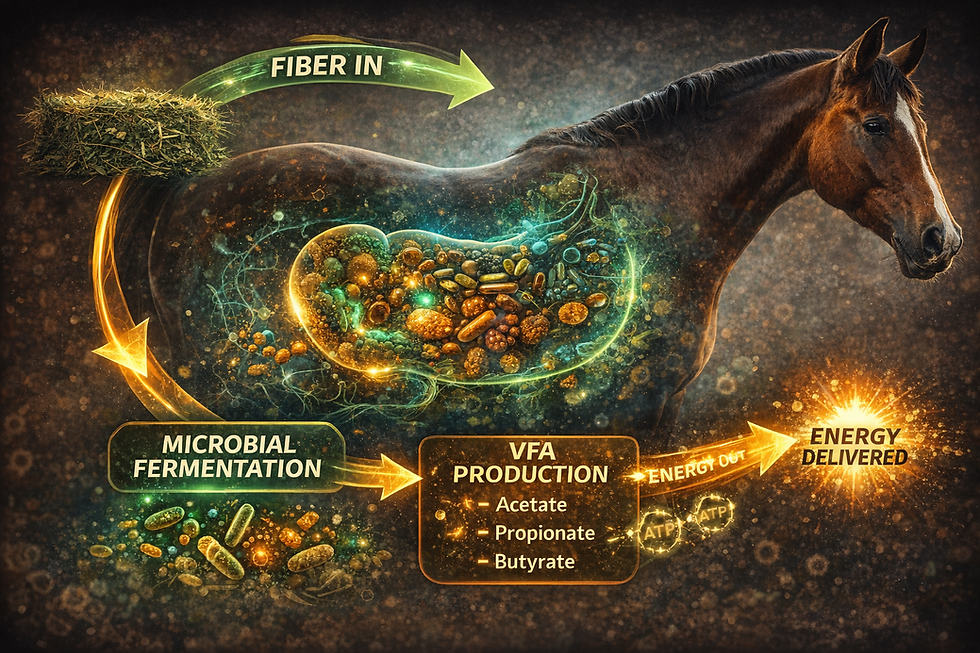
Your horse is not a small cow, a dog, or a machine that simply burns calories. The horse evolved to move, graze, chew, and process fibrous plant material steadily across the day. Deep within the digestive system sits a remarkable fermentation chamber, the hindgut, where billions of microbes help break down fibre and contribute to the horse’s overall wellbeing.
When that system is supported, horses often look, feel, and behave better.
When that system is disrupted, the signs can appear in many forms.
Problems Do Not Always Arrive Wearing a Digestive Label
Owners often look for obvious disease before they think about digestion. Yet horses can show tension, inconsistency, poor condition, dullness, irritability, loose manure, unpredictable behaviour, lack of bloom, or reduced trainability long before anyone says the word gut.
That is why the hindgut deserves attention. Not because it explains everything, but because it influences so much.
The Industry Loves Quick Fixes
The modern horse world can be noisy. There is always a new powder, a stronger promise, a dramatic testimonial, or a product positioned as the missing piece. Many owners are doing their best in good faith, but they are often sold solutions before the real questions are even asked.
How is the horse being managed?
How is it being fed?
How often does it move?
What stressors are present?
Is the feeding system aligned with the horse’s design?
What is happening in the digestive environment every single day?
Those questions are less glamorous than a miracle tub, but they are usually more valuable.
Balance Matters, But Biology Comes First
People often speak about balancing nutrients, and that certainly has a place. Deficiencies and excesses matter. Good formulation matters. Sound nutrition matters.
But numbers on paper do not automatically create a thriving horse if the digestive system is under pressure.
You can balance a ration beautifully and still overlook stress, feeding style, poor utilisation, inappropriate ingredients, confinement, irregular routine, pain, or chronic disruption to the microbial environment.
The spreadsheet is not the horse.
Nurture Before You Chase Complexity
In many cases, the biggest improvements do not come from doing something extreme. They come from doing basic things consistently and intelligently.
Respect forage.
Support regularity.
Reduce unnecessary stress.
Encourage movement.
Use feeds that work with the horse, not against it.
Observe manure, appetite, behaviour, and recovery.
Think system, not gimmick.
That is what nurturing the hindgut really means.
Why I Keep Hammering the Point
Because I have seen horses change when the fundamentals change. I have seen owners spend money in circles while overlooking the obvious. I have seen behaviour blamed when discomfort was present. I have seen horses maintained for years, then finally begin to bloom when the digestive foundation improved.
So yes, I will keep coming back to the hindgut.
Not because it is fashionable.
Not because it is an easy slogan.
Not because it sells hype.
Because understanding beats noise, and nurturing the horse’s natural design will always outperform shortcuts in the long run.
Final Thought
If the horse world shifted even a little from chasing quick fixes to protecting digestive foundations, many horses would live more comfortably and many owners would finally see the changes they have been searching for.
Comments