
Mycotoxins in Forage, What Every Horse Owner Should Know (Without the Panic)
- Dale Moulton
- Jan 31
- 3 min read

Most horse owners understand that mouldy hay is undesirable. What fewer people realize is that the real risk is not always the visible mould itself.
The deeper issue is something invisible, and far more biologically active:
Mycotoxins.
These compounds can exist even when hay looks mostly normal, and they can create vague, confusing health problems that are often misattributed to other causes.
This article is not about fear. It is about awareness, good management, and protecting the horse through informed decisions.
What Are Mycotoxins?
Mycotoxins are toxic compounds produced by certain fungi and mould species.
They are not “poison” in the dramatic sense, but they are biologically stressful chemicals that can affect multiple body systems, especially when exposure occurs over time.
Important point:
Mycotoxins are secondary metabolites, meaning the mould produces them under certain conditions, not always.
So not every mouldy bale contains dangerous levels, but no one can identify toxin risk accurately just by looking.
Where Do Mycotoxins Come From?
Mycotoxins can occur in forage when conditions support fungal growth, including:
Hay baled too wet
Poor curing conditions
Prolonged humid storage
Rain exposure during harvest
Internal heating in bales
Long-term storage without airflow
They are more common in compromised forage, but they can also occur at low levels in otherwise normal-looking hay.
Why Horses Are Sensitive
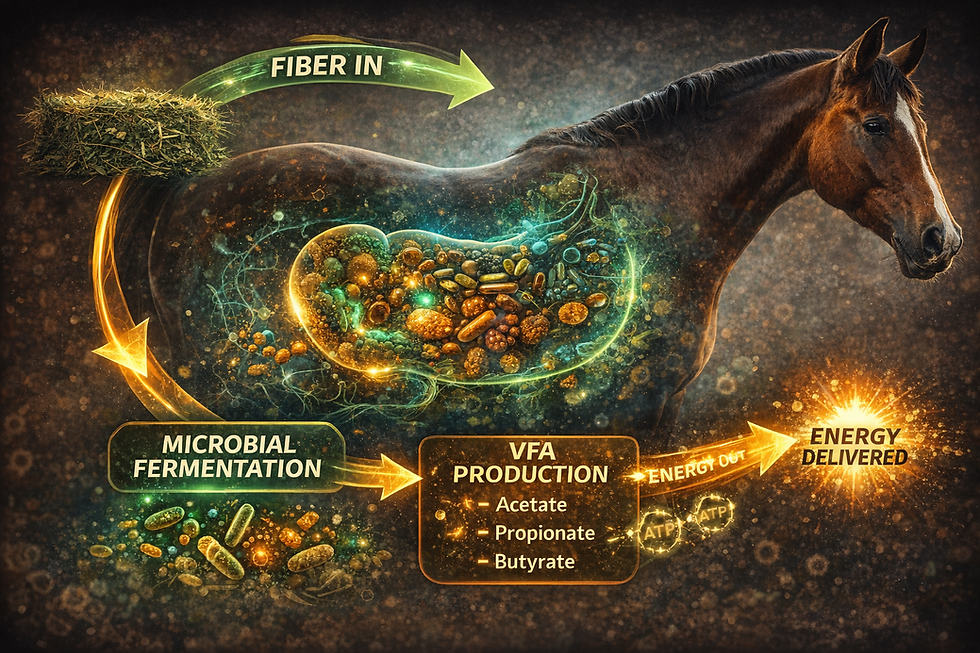
Horses are hindgut fermenters, meaning their digestive health depends on stable microbial balance in the cecum and colon.
Mycotoxins can disrupt this balance and place stress on:
The gut lining
The liver
Immune regulation
Neurologic function in severe cases
Because horses evolved to graze fresh forage continuously, their systems are not designed for repeated exposure to fungal toxins in stored feeds.
Signs of Mycotoxin Stress in Horses
This is where the subject becomes important.
Mycotoxin exposure rarely looks like one dramatic event. It more often appears as vague, inconsistent problems.
Possible signs include:
Reduced appetite or picky eating
Dull coat and poor topline
Weight loss despite adequate feed
Loose manure or intermittent digestive upset
Increased colic susceptibility
Lethargy or reduced performance
Unexplained immune weakness
Respiratory irritation from spore load
Occasionally, neurologic signs in extreme exposures
These signs are not specific, which is why mycotoxins are often overlooked.
The Hay Myth That Gets Horses Into Trouble
A common misconception is:
“If the horse eats it, it must be fine.”
That is not always true.
Horses do have instincts, but they can still consume contaminated forage when:
They are hungry
Better forage is unavailable
Toxins are unevenly distributed
Palatability masks the risk
A horse eating hay does not guarantee safety.
Can Mycotoxins Be Destroyed?
Here is the hard truth.
Mycotoxins cannot be reliably removed or neutralized by soaking, steaming, or drying.
Heat and water may reduce dust and spores, but toxins are chemically stable.
Once toxins are present, the correct solution is not treatment.
The correct solution is replacement.
Prevention Is the Entire Game
The best management is always proactive.
Horse owners should prioritize:
Buying hay from consistent, reputable growers
Inspecting every load, not just the top bales
Storing hay off the ground with airflow
Avoiding long-term storage in humid environments
Never feeding musty or visibly mouldy hay
Rotating inventory properly
When forage integrity is protected, toxin risk stays low.
What About Mycotoxin Binders?
Some products on the market claim to bind toxins in the digestive tract.
This is an area that requires caution.
Some binders are designed for poultry or cattle, not horses
Evidence in equine systems is variable
They must never be used as an excuse to feed poor forage
At Thrive Feed, the position is clear:
Binders are not a substitute for clean hay.
Thrive Feed’s Philosophy, Start With the Foundation
At Thrive Feed, we teach first principles.
The most advanced feeding program in the world cannot out-perform compromised forage.
Clean hay, clean water, digestive stability, and nutrient integrity come first.
Education is not marketing. It is protection.
If you control forage quality, most feeding problems disappear before they begin.
Final Thought
Mycotoxins are not a reason to panic.
They are a reason to be disciplined.
Most horses thrive for a lifetime on good hay, managed properly. The risk arises when mould and moisture are tolerated as “normal.”
If hay smells wrong, looks wrong, or feels questionable, the answer is simple:
Do not feed it.
Horses deserve better than invisible compromises.
Comments