
The Absolute Foundation of Equine Health and Performance


The Power of Cellulolytic Bacteria That Power Your Horse.
The horse was designed by nature to live on forage, not on grain, oil, or highly processed feeds that bypass the normal digestive sequence. At the core of equine health lies one of the most remarkable biological partnerships in nature: the relationship between the horse and the trillions of microorganisms living in its hindgut.
Among these microorganisms, the most important are the cellulolytic bacteria, the specialist microbes responsible for breaking down structural carbohydrates such as cellulose and hemicellulose found in grass and hay.
These bacteria do far more than simply digest fiber.
They manufacture three critical byproducts that form the foundation of equine health and performance.
1. Volatile Fatty Acids (VFAs), The Horse’s Primary Energy Source
Volatile fatty acids
When cellulolytic bacteria ferment fiber, they produce three principal volatile fatty acids:
Acetate
Propionate
Butyrate
These VFAs are absorbed directly through the wall of the cecum and colon and provide the majority of the horse’s daily energy requirements.
Acetate
Acetate is the most abundant VFA and is used as a major fuel source for muscles and other tissues.
Propionate
Propionate travels to the liver, where it is converted into glucose, supplying a steady and controlled source of blood sugar.
Butyrate
Butyrate is the preferred energy source for the cells lining the colon and plays a crucial role in maintaining intestinal integrity.
Why This Matters
Most horse owners assume grain provides the energy that powers the horse. In reality, the healthy horse obtains most of its energy from microbial fermentation of fiber.
The horse is, in effect, powered by bacteria.
2. Microbial Protein, A Source of Amino Acids
Microbial protein
As cellulolytic bacteria grow and reproduce, they create their own highly digestible protein.
This microbial biomass contains essential amino acids, enzymes, and other nutrients.
In ruminants such as cattle, much of this microbial protein is digested and absorbed in the small intestine. In horses, because fermentation occurs after the small intestine, only limited amounts may be recovered through hindgut absorption and cecotrophy is not a normal feeding strategy.
Even so, microbial protein remains a marker of a healthy and productive microbial ecosystem.
Why It Matters
A thriving microbial population reflects efficient fermentation, superior fiber utilization, and improved nutrient extraction from forage.
3. B Vitamins, Nature’s Internal Supplement Factory
B vitamins
Cellulolytic bacteria synthesize many B vitamins, including:
Biotin
Thiamine (B1)
Riboflavin (B2)
Niacin (B3)
Folate (B9)
Cobalamin (B12, in limited amounts depending on cobalt availability)
These vitamins are involved in:
Energy metabolism
Nerve function
Hoof integrity
Red blood cell production
DNA synthesis
Biotin and Hoof Health
Biotin is particularly important for keratin production and hoof strength. In a well-functioning hindgut, beneficial bacteria continuously manufacture this nutrient.
The Hidden Workforce Inside Every Horse
The horse is not nourished by forage alone.
It is nourished by what its microbial partners produce from forage.
When the hindgut is healthy, cellulolytic bacteria transform fiber into:
Volatile fatty acids for energy
Microbial protein as a measure of robust fermentation
B vitamins for metabolic support
This is the biological engine that has sustained horses for millions of years.
When This System Breaks Down
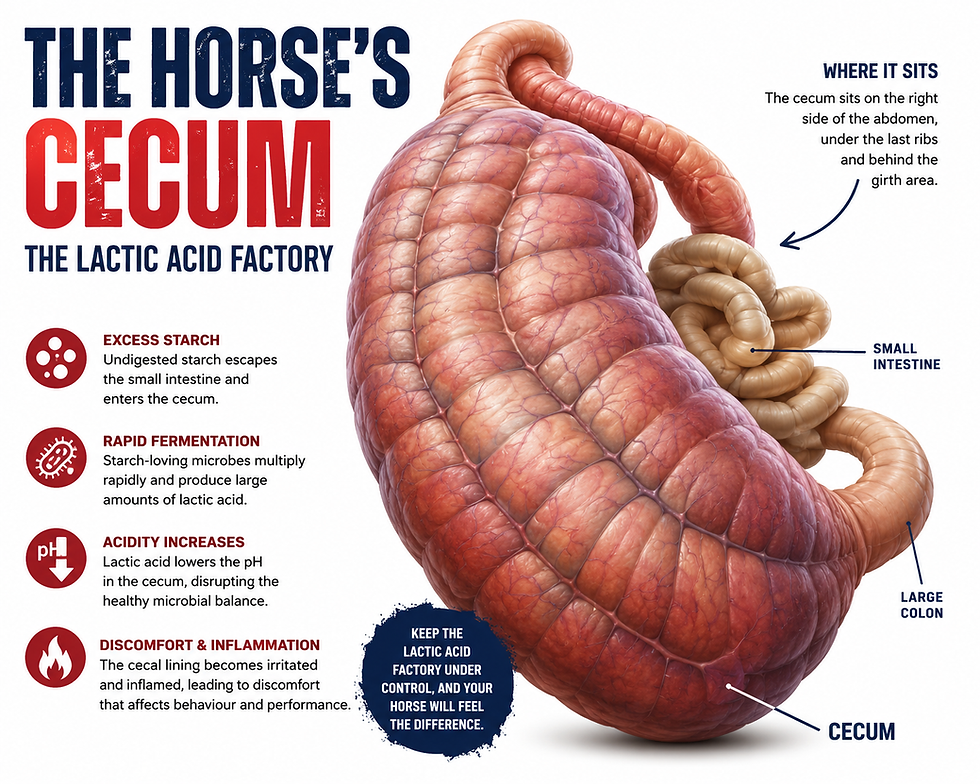
Diets high in raw starch, excessive sugar, abrupt feed changes, and poor-quality nutrition can suppress cellulolytic bacteria and destabilize the hindgut ecosystem.
When these bacteria are compromised:
Fiber digestion declines
Energy production falls
Vitamin synthesis decreases
Hindgut acidity may rise
Colic and laminitis risk increases
The result is often a horse that appears dull, inconsistent, uncomfortable, or difficult to keep in condition.
You Are Not Feeding a Horse, You Are Feeding a System
This principle sits at the heart of Thrive Feed.
Every mouthful should support the microorganisms that convert forage into the nutrients horses were evolved to use.
When you nourish the hindgut correctly, the horse can express its natural potential for health, resilience, and performance.
Final Thought
A horse is a host to a living fermentation system.
The real workers are invisible.
They digest the fiber.
They manufacture the fuel.
They help maintain the internal environment.
And they do it continuously, every hour of every day.
Take care of the cellulolytic bacteria, and they will take care of your horse.


Comments