
The Equine Hindgut, The Engine You Never See.


When people say “it’s time to feed the horse,” they are already starting from the wrong premise.
You are not feeding a horse.
You are feeding a microbial ecosystem, and that ecosystem lives in the hindgut.
The horse itself is simply the host.
What the Hindgut Actually Is
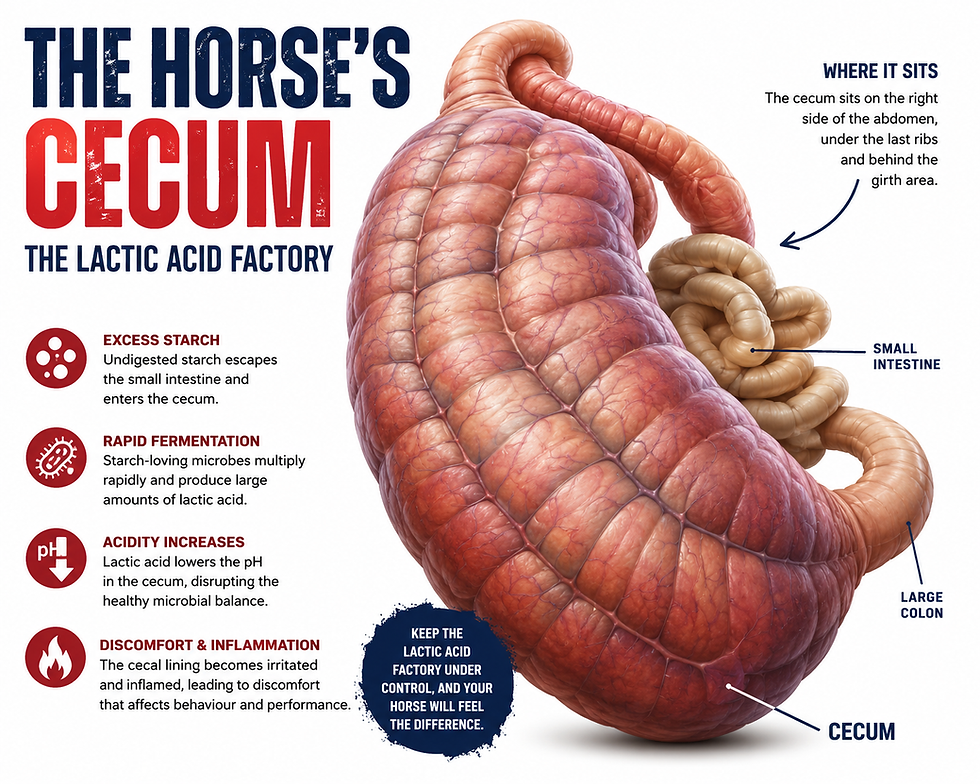
The hindgut is made up of the cecum and colon, and it functions as a large fermentation chamber. It is not a minor part of digestion, it is the primary engine of energy production in a horse.
Inside this chamber lives a dense and highly specialised microbial population, primarily cellulolytic bacteria. These microbes break down structural carbohydrates, fibre, and plant material that the horse itself cannot digest.
The end result of this process is the production of volatile fatty acids, acetate, propionate, and butyrate. These are not byproducts, they are fuel. This is where the majority of the horse’s usable energy actually comes from.
If the hindgut is functioning correctly, the horse runs clean, calm, efficient, and metabolically stable.
If it is not, everything starts to unravel.
The Fatal Misunderstanding
The industry has spent decades focusing on what goes into the front end of the horse, protein levels, fat percentages, and crude energy calculations, while largely ignoring what happens in the hindgut.
Here is the reality.
The hindgut is not designed to handle large amounts of raw starch.
When undigested starch escapes the small intestine and enters the hindgut, it feeds the wrong microbial population. Instead of supporting fibre-digesting bacteria, you promote rapid fermentation by lactic acid producing species.
This causes a drop in pH, a state known as hindgut acidosis.
Once that happens, the system destabilises.
Beneficial bacteria die off, toxins are released, gut lining integrity is compromised, and the horse begins to show signs that people often misinterpret as unrelated issues.
What Hindgut Dysfunction Actually Looks Like
It does not always present as dramatic colic.
More often, it shows up as:
Unexplained behaviour changes
Inconsistent performance
Poor topline despite adequate feeding
Loose manure or fluctuating manure quality
Sensitivity, reactivity, or “edge” under saddle
Laminitic tendencies or metabolic instability
People chase these symptoms one by one.
The problem is upstream, or more accurately, downstream.
The Horse is a Fermenter First
A horse evolved as a continuous grazer, consuming small amounts of fibrous material over long periods. This creates a steady, controlled fermentation environment in the hindgut.
Modern feeding practices often do the opposite.
Large, infrequent meals
High starch inputs
Feeding schedules driven by human convenience rather than biological design
This creates peaks and crashes in fermentation, instability in pH, and constant disruption to the microbial population.
You cannot build a stable system on instability.
The Goal, Stability
If you want a healthy horse, your primary objective is simple.
Create and maintain a stable hindgut environment.
That means:
Consistent intake
Controlled starch delivery
Support for cellulolytic bacteria
Avoidance of sudden dietary changes
Feeding patterns that mimic natural grazing behaviour
When you do this, the microbial population stabilises.
When the microbes stabilise, fermentation stabilises.
When fermentation stabilises, the horse stabilises.
A Shift in Thinking
This is where the entire conversation needs to change.
Stop asking, “What does the horse need?”
Start asking, “What does the hindgut need?”
Because if you feed the hindgut correctly, the horse will take care of itself.
Final Thought
The hindgut is not a secondary system.
It is the foundation.
Ignore it, and you will spend your time chasing problems.
Understand it, and you will start preventing them.


Comments