
Why the Gut Is the Second Brain of the Horse
- Dale Moulton
- Jan 25
- 2 min read

Horse owners often separate two things in their minds:
Digestion, and behaviour.
They think the gut is one system, and temperament is another.
But the horse does not work that way.
In horses, the gut is not just a digestive organ.
The gut is a nervous system influence.
In many ways, it is the horse’s second brain.
The Hindgut Is the Centre of the Horse
A horse is a hindgut fermenter.
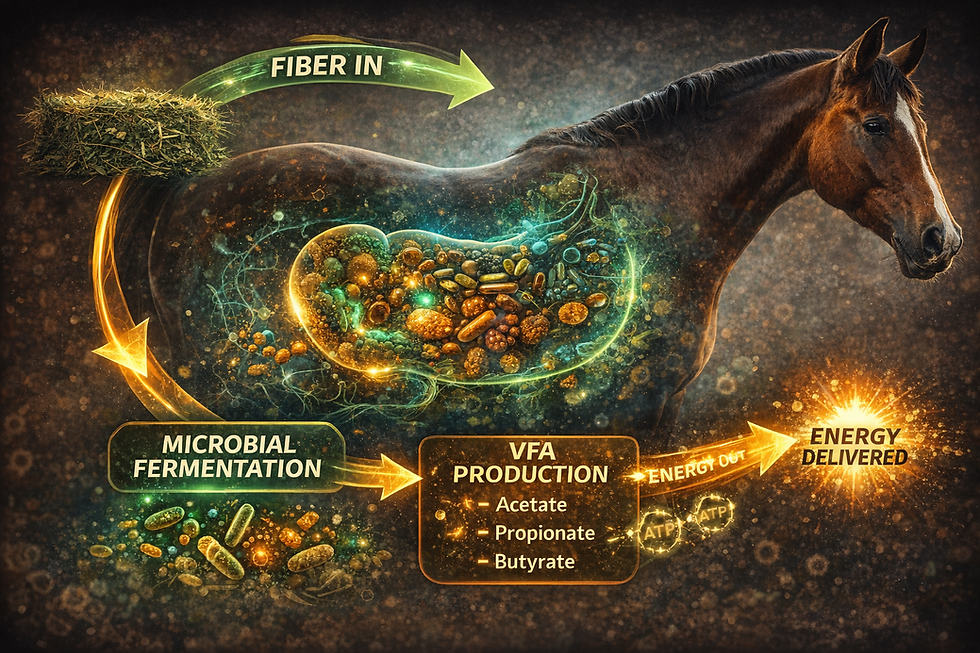
That means the horse’s entire biology depends on microbial fermentation of fibre.
Most of the horse’s energy, stability, and resilience come not from grain, but from fermentation.
If the hindgut is calm, the horse is often calm.
If the hindgut is unstable, the horse is rarely settled.
The Gut and the Nervous System Are Linked
The digestive tract is rich in nerve pathways and chemical signalling.
When digestion is disrupted, the horse does not just develop manure changes.
The horse develops changes in mood, reactivity, and stress tolerance.
Owners often describe it as:
“He’s just not himself.”
That is often the gut speaking.
Gut Instability Creates Whole-Horse Instability
When fermentation becomes erratic, when feeding is inconsistent, when starch loads overwhelm fibre rhythms, the horse becomes biologically unsettled.
This can express as:
Irritability
Spookiness
Poor focus
Sensitivity under saddle
Unpredictable energy
Difficulty maintaining condition
The horse is not being naughty.
The horse is being physiologically challenged.
Calm Feeding Produces Calm Horses
The modern feed industry often chases “energy.”
But true energy in a horse is not excitement.
True energy is calm endurance, stable metabolism, predictable behaviour.
That comes from digestive stability.
A horse with a settled hindgut often shows:
Better attitude
Improved consistency
More willingness
Greater resilience
More even performance
This is not magic.
It is biology.
Forage Is the Foundation of the Second Brain
The horse was designed for steady fibre intake.
The gut expects rhythm.
When feeding patterns contradict that expectation, the horse’s internal world becomes unsettled.
That is why evolution-aligned feeding is so powerful.
It restores stability at the centre.
Thrive Feed Supports the Horse Where the Horse Lives
Thrive Feed exists because most modern horses are living under conditions that challenge the gut:
Intermittent feeding
Rich pasture surges
Confinement
Stress
Dietary inconsistency
Thrive Feed is designed to support calm digestive function, because the gut drives the horse.
When the gut improves, everything improves.
Final Thought
The gut is not just where food is processed.
It is where the horse’s stability is built.
A calm gut creates a calm nervous system.
A settled fermentation creates a settled horse.
If you want to understand behaviour, start with digestion.
Because in the horse, the gut truly is the second brain.

Comments