
Winter Horses Are Not Fragile
- Dale Moulton
- Jan 28
- 3 min read

Cold Weather Management, Coat Biology, and the Confidence of a Well Fed Horse
When winter hits hard, many owners assume horses need to be protected from cold in the same way people do. Rugs come out, routines change, and anxiety rises.
But the horse is not a human in a paddock.
The healthy horse is one of the most winter capable animals on earth.
Given the chance, the horse grows the coat it needs, adapts its metabolism, and often thrives in conditions that surprise us.
I learned this over decades with my own horses, and one of the clearest examples was a rescue, an Egyptian Arabian I named Raz.
Raz, the Desert Horse Who Loved Snow
Raz was as desert bred as they come, yet winter weather was his favorite season. When snow arrived, he did not endure it.
He celebrated it.
He would throw himself down and slide around in the worst weather with absolute joy, while my Quarter Horses stood watching him as if he had lost his mind.
The harsher the conditions, the more alive he seemed.
That experience taught me something important.
Cold is not automatically the enemy.
Poor management is.
The Winter Coat Is a Biological System
A horse’s winter coat is not just longer hair. It is an adaptive insulation system.
When horses are allowed to experience normal seasonal change, they grow coats that trap warm air, repel moisture, and regulate temperature remarkably well.
Constant blanketing and artificial interference can sometimes disrupt that natural adaptation, especially when used unnecessarily.
The goal is not to never rug.
The goal is to understand when the horse truly needs help, and when the horse is perfectly equipped already.
Shelter Matters More Than Blankets
In most winter conditions, horses do not need heavy covering, they need options.
A windbreak.
A run in shed.
Dry footing.
The ability to get out of driving rain.
Wind and wet are far more challenging than cold air alone.
A dry horse with shelter can handle extraordinary temperatures.
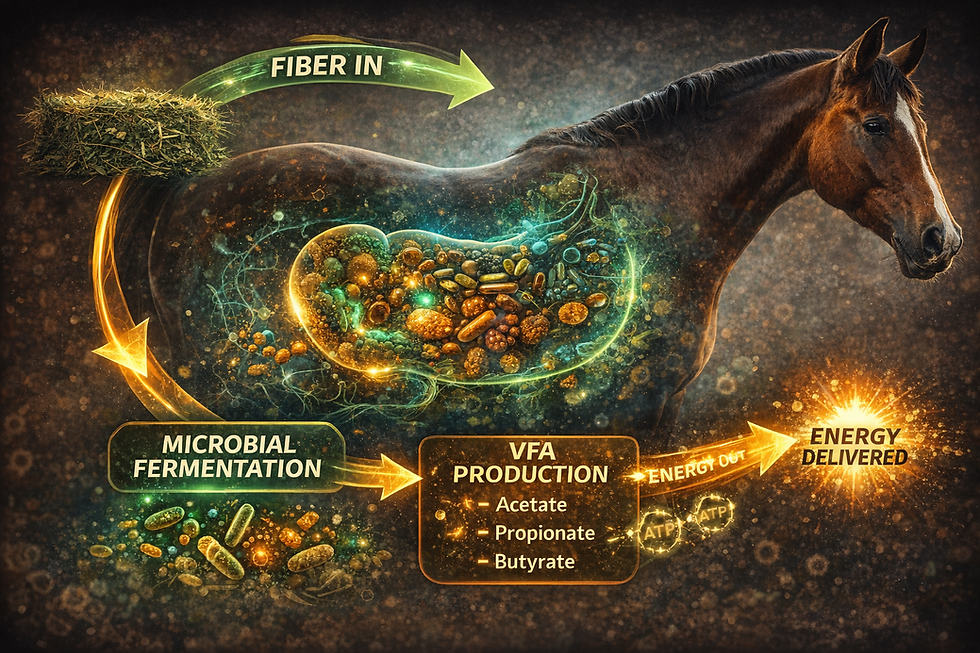
Feeding Is the Real Winter Heater
Winter warmth is built from the inside.
The horse’s furnace is the hindgut, where fermentation of fiber generates significant heat. This is why forage is the foundation of winter management.
If you want to support a horse through cold weather, you do not start with synthetic insulation.
You start with adequate forage and steady nutrition.
Seasonal Feeding, Matching Nature
One principle I have always followed is feeding in a way that respects the season.
When pasture is brown, the horse is not living on spring grass.
Winter is not the time for sudden dietary mismatch.
The horse needs consistency, fiber, and a feeding program aligned with the reality of the ground.
Horses do best when management matches the season rather than fighting it.
When Horses Do Need Extra Support
Cold weather management is not neglect. It is judgment.
Horses may need additional support when they are:
Older or underweight
Clipped and in work
Ill or recovering
Exposed to prolonged cold rain without shelter
Unable to maintain condition
The goal is always the same.
Support the horse, do not smother the horse.
Thrive Feed’s View
At Thrive Feed, we believe winter management is about biological respect, not panic.
Horses are designed for winter.
Coats are designed for winter.
Fiber fermentation is designed for winter.
Routine, shelter, and steady nutrition are the real tools.
Because a regulated, well fed horse does not fear the season.
Often, like Raz, the horse falls in love with it.
Comments