
Horses Live on Carbohydrate. Humans Do Not, By Design.

We have been talking about weight, about obesity in horses, about rider responsibility, and about metabolic strain. The next logical step is to look at something most people never question.
Horses live on carbohydrate.
Humans do not, at least not in the way modern society consumes it.
This is not my opinion. This is comparative biology.
The Horse Is Built to Run on Structural Carbohydrate
A horse is a hindgut fermenting herbivore. Its entire digestive architecture is designed around extracting energy from fiber.
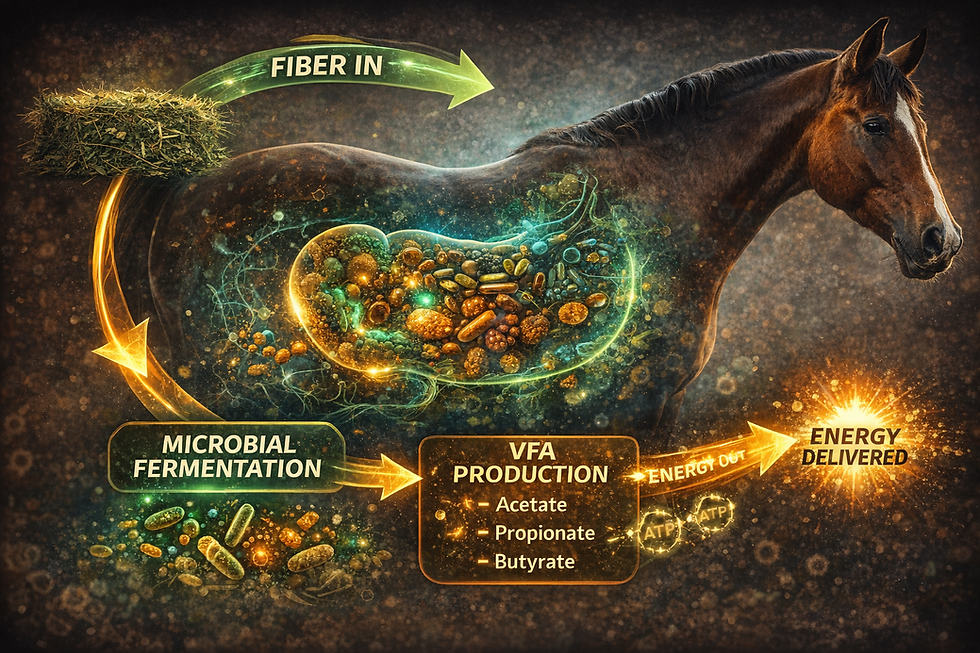
The horse has a relatively small stomach and an enormous cecum and colon. That hindgut is home to billions of cellulolytic bacteria whose job is to ferment structural carbohydrate, cellulose and hemicellulose from grasses and forage.
Through fermentation, those microbes produce volatile fatty acids, acetate, propionate, and butyrate. These fatty acids are absorbed through the gut wall and become the horse’s primary fuel source.
A grazing horse does not experience blood sugar spikes the way a human does after eating refined carbohydrate. It experiences a slow, steady fermentation curve. Energy release is controlled and consistent.
That is why pasture, when managed correctly, aligns with the horse’s design.
When we override that design with excessive non structural carbohydrates, high starch grains, sugar rich feeds, or inappropriate feeding frequency, we see the consequences. Laminitis, hindgut acidosis, colic, behavioral volatility, and metabolic dysfunction follow.
The horse is absolutely a carbohydrate animal, but specifically a structural carbohydrate animal that relies on microbial fermentation.
Without fiber fermentation, the horse cannot function.
Humans Are Metabolically Flexible
Humans are omnivores. More importantly, we are metabolically flexible.
We do not possess a fermentation chamber capable of extracting meaningful calories from cellulose. If you eat grass, you gain virtually nothing from it. Our large intestine is small compared to a horse’s hindgut and plays only a minor role in energy extraction.
Instead, humans have a long small intestine designed to absorb fats, proteins, vitamins, and simple carbohydrates. We produce salivary amylase to begin starch digestion, and our pancreas regulates blood glucose through insulin.
However, here is the key difference.
Humans can thrive without dietary carbohydrate.
The human brain requires glucose, but it does not require that glucose to come from refined carbohydrate. The liver can manufacture glucose internally through gluconeogenesis using amino acids and glycerol. We are capable of using fat as a primary fuel source. We are capable of fasting. We are capable of shifting between fuel systems.
That metabolic flexibility is part of our evolutionary design.
A horse cannot choose to burn fat in place of fiber fermentation. (Goodbye Senior Feed). A human can shift from glucose metabolism to fat oxidation when carbohydrate intake is reduced and insulin levels stabilize.
That distinction matters.
What Changed in the Modern World
The issue is not carbohydrate itself. It is context, dose, and processing.
Modern humans are exposed to constant refined carbohydrate. Ultra processed starches, added sugars, liquid calories, and relentless eating frequency create repeated insulin spikes throughout the day.
Each spike is followed by a decline in blood glucose. That decline triggers hunger, fatigue, and often another carbohydrate intake. Over time, this creates a biochemical loop, not a moral failure, but a physiological cycle of craving and compensation.
Many people are not weak. They are riding blood sugar swings.
Contrast that with a horse grazing pasture. The horse’s energy curve is slow and continuous because fermentation is slow and continuous.
Humans were not designed for constant refined carbohydrate exposure. We were designed for periods of abundance and periods of scarcity. For metabolic rest between meals. For fat oxidation as much as glucose utilization.
When we feed a species in a way that contradicts its design, disease follows.
The Parallel That Matters
When we feed horses high starch, sugar rich diets that exceed their biological design, we see laminitis, insulin dysregulation, and chronic inflammation.
When humans consume high refined carbohydrate diets that exceed our biological design, we see obesity, insulin resistance, type 2 diabetes, fatty liver disease, and chronic inflammation.
Different species.
Same principle.
Mismatch between biology and modern feeding practice.
This is not about blame. It is about alignment.
Horses live on structural carbohydrate because their entire digestive system is built for fermentation.
Humans are not built that way. We are built for flexibility.
Understanding that difference is not just interesting. It is empowering. Because when we respect design, we improve outcomes.
Knowledge first. Action second!

Comments