
The Coat Is the Mirror of the Gut

One of the first things people notice about a horse is its coat.
A dull coat.
A rough coat.
A coat that will not shed properly.
Or the opposite, a horse that begins to bloom with softness and shine.
Owners often think of coat condition as something cosmetic.
But in horses, the coat is rarely just about appearance.
The coat is often a mirror of what is happening inside the gut.
The Outside Reflects the Inside
A horse’s coat is built from nutrients, but those nutrients must first be digested, absorbed, and utilised.
If digestion is unsettled, the coat often shows it before anything else does.
The horse may be eating plenty.
But the system may not be functioning calmly.
Hair Growth Is a Metabolic Priority Only When the Body Is Stable
The horse’s body is always making decisions about energy allocation.
When the horse is under stress, whether digestive, inflammatory, or environmental, the body shifts toward survival priorities.
Coat quality becomes secondary.
That is why a stressed horse often looks different, even if nothing obvious has “changed.”
The coat tells the story.
The Hindgut Drives Condition
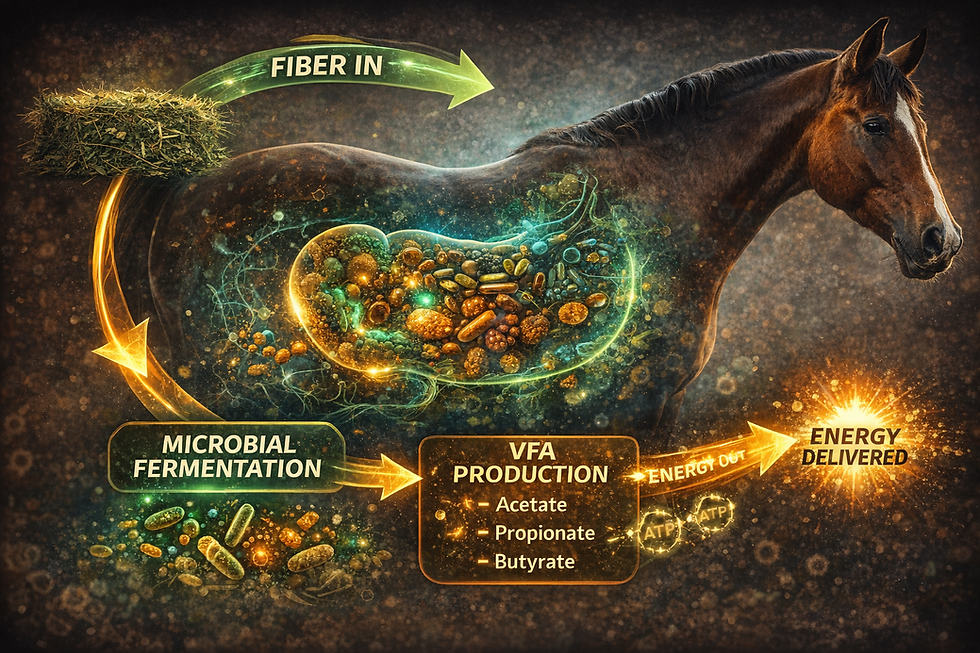
Horses are hindgut fermenters.
Their energy and stability come largely from the fermentation of fibre.
When the hindgut is functioning smoothly, the horse is more likely to maintain:
Consistent body condition
Stable temperament
Strong immunity
Healthy coat expression
A calm gut often produces a calm, healthy horse, inside and out.
Dull Coats Are Often Signs of Burden
A coat that loses its softness can be associated with many underlying pressures:
Digestive instability
Inconsistent forage access
Chronic low-grade inflammation
Stress
Parasite burden
Poor chewing due to dental issues
Abrupt dietary changes
The coat is not the problem.
The coat is the signal.
Seasonal Change Can Make It More Obvious
Many horses seem to “change” dramatically during seasonal coat transitions.
That is when new hair growth demands more resources, and any internal instability becomes visible.
This is why owners often notice coat improvement or dullness most strongly during shedding or winter coat development.
Feeding for Calm Function Shows in the Coat
The goal is not to chase shine as a cosmetic trick.
The goal is to support the horse’s natural baseline through consistency and digestive calm.
When the gut is stable, many horses simply begin to look more like themselves.
Not transformed.
Just supported.
Final Thought
A glossy coat is not a miracle.
It is often a reflection of internal stability.
The coat is the mirror of the gut.
When digestion is calm, fermentation is steady, and the horse’s system is not carrying unnecessary burden, the outside often begins to reflect the inside.
Because horses have not changed.
They still express health the way nature intended, from the gut outward.

Comments