
The Horse’s Teeth, Natural Design, Modern Damage, and the Problem With Over-Floating
- Dale Moulton
- Jan 25
- 3 min read


One of the most overlooked foundations of equine health is the horse’s mouth.
Before digestion begins in the stomach, before nutrients reach the hindgut, before any feed can do its job, the horse must do something very specific:
It must mechanically prepare forage.
And that preparation depends entirely on the natural structure of the horse’s teeth.
The Horse’s Dentition Is an Evolutionary Tool
A horse’s teeth are not random chewing blocks.
They are highly specialised grinding surfaces, shaped over millions of years to do one job:
Rupture, shred, and prepare fibrous plant material for fermentation.
The horse does not “chew like a cow.”
It grinds laterally, with a very specific occlusal angle and surface pattern that matches forage structure.
This is the first step of digestion.
If the mouth fails, the gut pays the price.
Modern Feeding and Modern Dentistry Have Created Modern Problems
It is true that domestic horses often develop sharp points, hooks, and imbalances.
But it is equally true that many of these issues are not simply “nature’s mistake.”
They are often the result of modern conditions:
Reduced grazing hours
Softer diets
Stabled confinement
Less natural tooth wear
Abnormal jaw mechanics
Human-imposed feeding patterns
Feral horses do not have equine dentists.
They do not have power floats.
And yet they survive for decades on forage alone.
That should make us pause.
The Overzealous Use of Power Floating
There is no question that skilled dentistry has an important role when true pathology exists.
But there is also an increasing trend in the industry:
Over-floating with power equipment.
When dentistry becomes aggressive, routine, or cosmetically driven, the horse can lose something critical:
Its natural dentition.
Power floating can remove the very tooth structure the horse needs for effective forage rupture.
Instead of preserving function, it can unintentionally polish it away.
The result can be a horse that struggles to process long-stem forage properly, not because of age, but because its grinding surfaces have been flattened beyond their biological intent.
Teeth Are Designed to Rupture Fibre, Not Create Smooth Perfection
Grass is not soft.
Hay is not soft.
Forage requires rupture.
The horse’s molars are shaped with ridges and angles that tear plant fibres before grinding them into digestible particles.
In many ways, the natural tooth function is similar to what a hammer mill does in the production of Thrive Feed:
Breaking structure to allow fermentation and nutrient availability.
Destroy the structure, and preparation becomes inefficient.
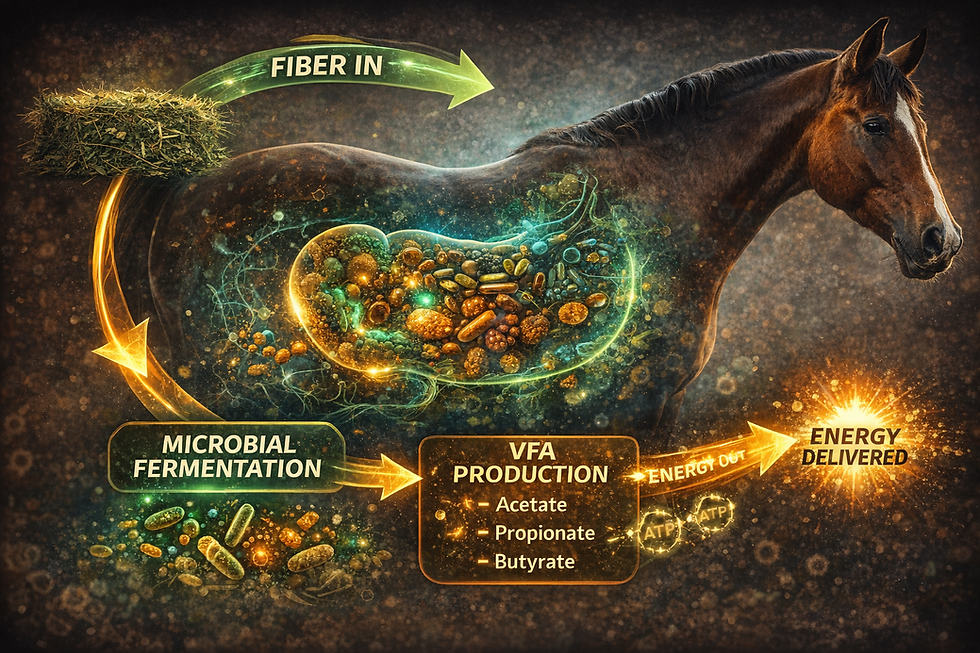
The horse may still eat, but the digestive system receives larger, less prepared fibre, increasing the load on the hindgut.
A Mechanical Problem Becomes a Digestive Problem
Poor oral preparation can contribute to:
Quidding
Weight loss despite adequate feed
Digestive instability
Reduced forage utilisation
Behavioural tension under saddle
Chronic low-grade stress
The mouth is the first digestive organ.
A horse cannot thrive if the mouth is compromised.
A Call for Functional Restraint
This article is not an attack on good equine dentistry.
It is a call for restraint, skill, and biological respect.
Dentistry should be:
Functional
Conservative
Horse-specific
Preserving natural structure
Addressing genuine problems, not overcorrecting anatomy
The goal is not to create an artificially perfect mouth.
The goal is to preserve the mouth the horse was designed to have.
Final Thought
The horse evolved to graze, grind, and digest forage without modern intervention.
When we interfere too aggressively with the teeth, we interfere with the very first step of digestion.
Horses do not need cosmetic dentistry.
They need functional mouths.
And the industry must begin thinking less about machinery…
And more about nature.

Comments